The last two weeks have been the most volatile stretch in technology stocks in years. On November 12, Nvidia announced that co-founder and CEO Jensen Huang had resigned. By Friday, the selloff in AI-related stocks pushed the market into correction territory. This morning, after Trump’s verbal support, Nvidia’s board unanimously reinstated Huang, and the stock closed up more than 30%, its third-best day on record. Global markets rallied with it. Exhausting.
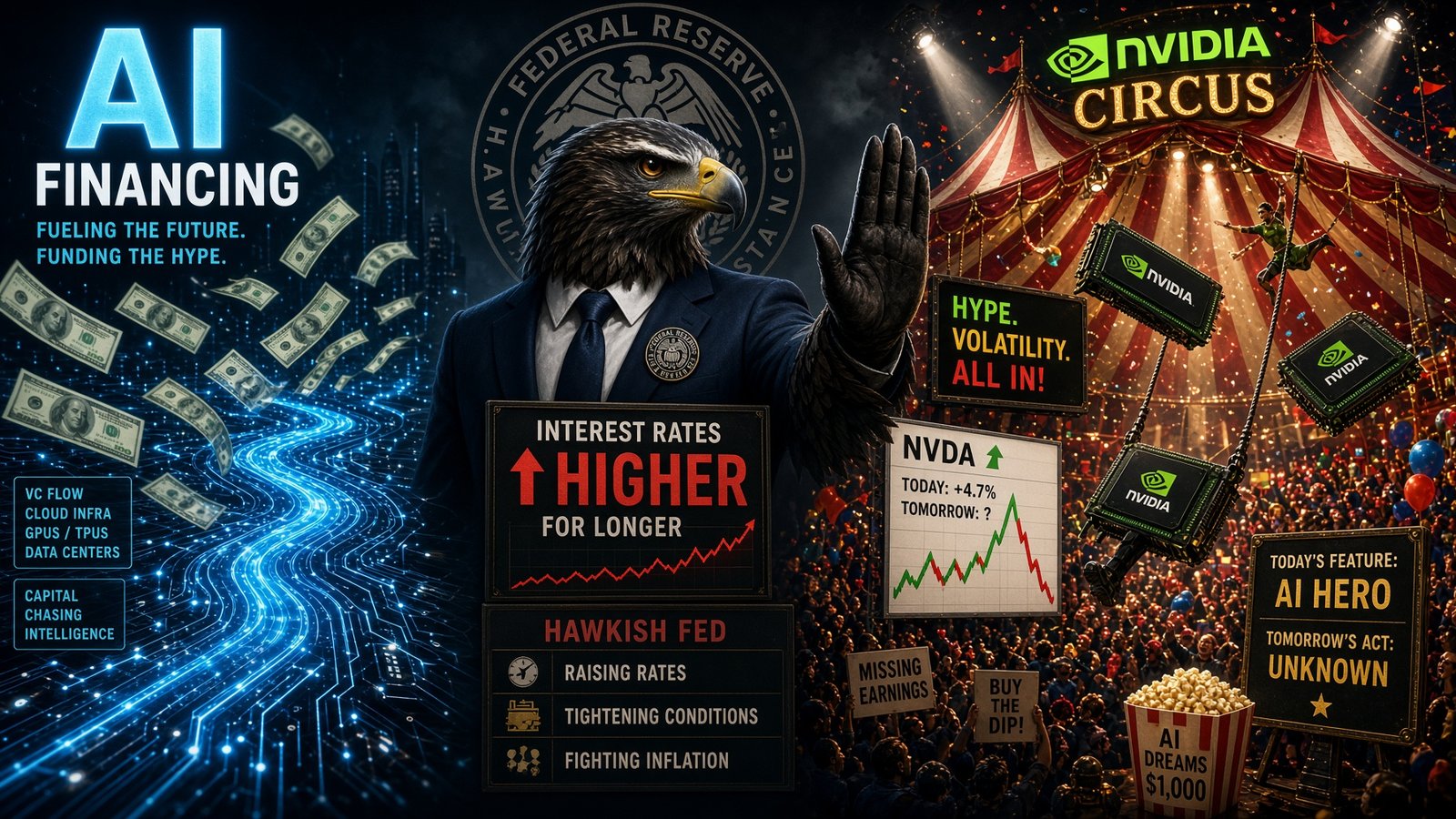
It would be easy to read today’s rebound as “crisis over.” We don’t think that’s the right takeaway. Huang’s departure didn’t create the market’s problems. It exposed two that were already there, and neither was solved with his reinstatement this morning.
Theme 1: The AI Build-Out Is Running Into a Financing Wall
Why one CEO moved the whole market. Nvidia is not just the company selling the chips that power AI. Over the past two years it has become one of the industry’s biggest financiers in what the analysts call “circular financing”. As of October 25, 2026, Nvidia holds a $30 billion stake in OpenAI which is part of its $109.7 billion in public and private securities holdings which include CoreWeave, Anthropic and other companies that, in turn, buy Nvidia’s chips. Nvidia has also taken on as much as $118 billion in guarantees that lenders and landlords are banking on for datacenter builds. Huang was widely seen as the personal force holding the incestuous arrangements together. When he left, investors had to ask whether that support would continue. That is why the selloff hit AI names so hard, not just Nvidia itself.
Circular financing is not a new invention. Lucent and Nortel financed their own customers through the telecom build-out of the late 1990s, and the loans looked like revenue until they became write-downs. What is different this time is scale and concentration with one company’s balance sheet.
The bond market saw this coming. Stock investors were cheering the AI story well into the fall, but bond investors had been demanding steadily higher compensation to lend to it for months:
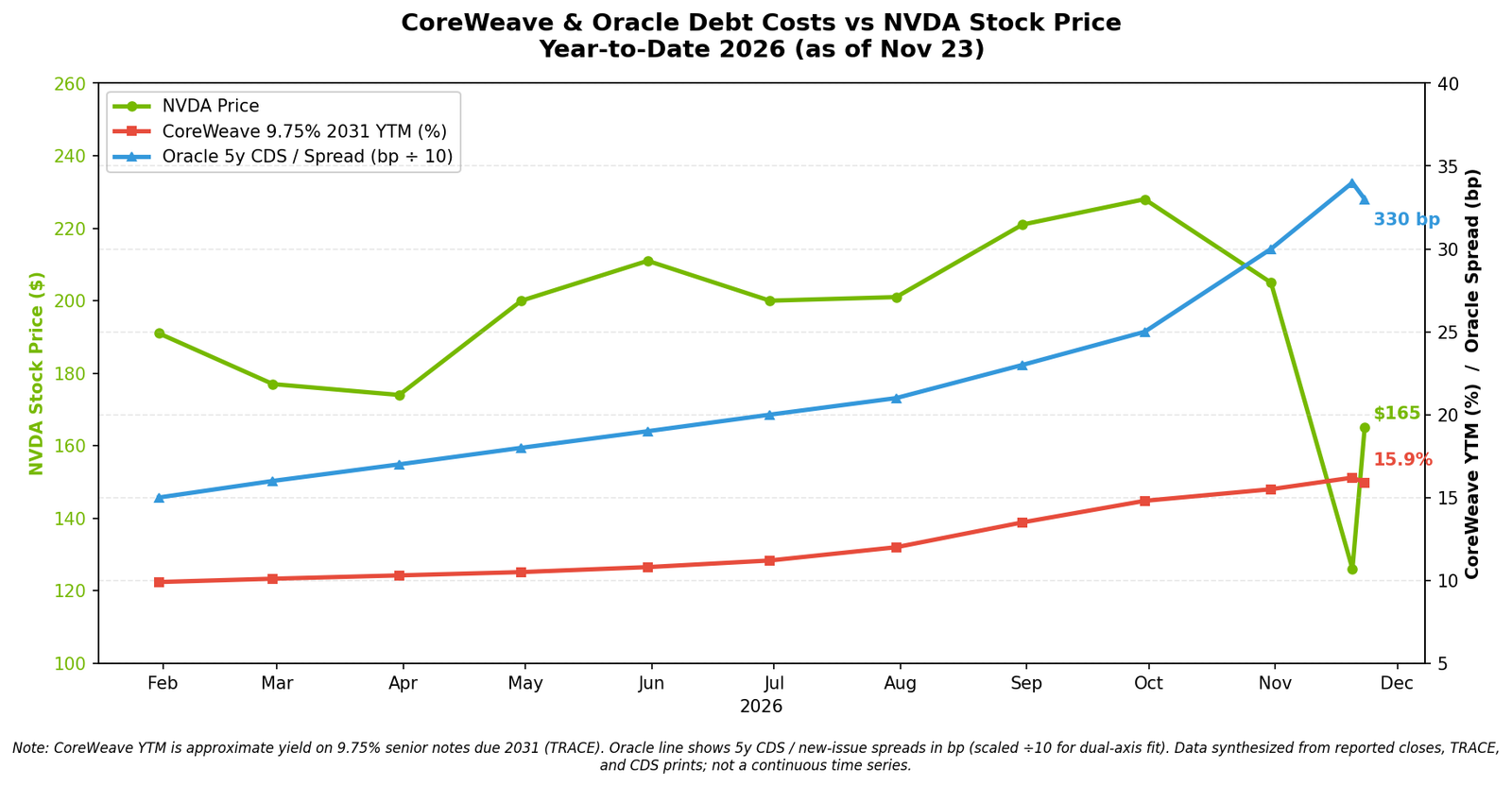
- CoreWeave, a major AI data-center operator carrying roughly $50 billion in debt and obligations, has seen its bonds trade at yields above 16%
- Oracle’s credit default swap spread (credit insurance) climbed past 340 bps
- Last Thursday, SpaceX, arguably the strongest name in the AI ecosystem, raised $32 billion to buy Nvidia chips, with the largest portion yielding 8.259%. This is well above the 5.86% SpaceX paid on its own bonds in June.
The SpaceX deal is the tell. It was structured to keep the debt off SpaceX’s balance sheet and was backed by the chips themselves, so it isn’t a clean read on SpaceX’s own credit. That is exactly the point. Even with collateral and a premier sponsor, lenders demanded more than 8%. Weaker borrowers in the AI chain will face steeper terms, and some planned projects will not get financed at all. Collateral doesn’t make a loan cheap when the lender doubts its resale value.
What this means. The AI build-out has been heavily debt-funded, and that debt is getting more expensive. If financing tightens further, it means less spending on data centers and chips, slower growth for the companies that supply them, and pressure on valuations that assumed spending would continue indefinitely. A credit squeeze of this kind is disinflationary: it slows spending, weakens demand and pushes investors toward safety.
Huang’s return restores the leadership gap. It does not change the math on interest costs, and Nvidia still faces open SEC and Department of Justice inquiries. We expect the financing question to remain the market’s central concern going into 2027.
Theme 2: A Strong Dollar and a Fed Determined to Fight Inflation
Kevin Warsh has a new playbook. He became Federal Reserve chair in May, and he has made fighting inflation his clear priority, describing inflation as a “choice.” The Fed raised rates in September for the first time in three years and has signaled more will come.
Since Warsh took the chair in mid-May, the U.S. Dollar Index has climbed from below 98 to about 104.3 today (DXY Curncy) a gain of roughly 6.5% and its strongest level since spring 2025. A stronger dollar is a headwind for commodity prices, which are priced in dollars, and for international stocks, whose returns shrink when converted back into dollars.
Why the inflation picture is more complicated than it looks. Inflation did rise this year, and much of it came from the war with Iran. Gasoline averaged about $4.27 a gallon in late October, up from $2.98 before the conflict. Consumer prices rose 3.7% through September as fuel costs were passed on to most products.
The item that most people forget is that energy supply shocks are often self-correcting. Higher energy costs increase prices, which reduce demand for goods and services as budgets are squeezed. This often creates recessionary pressure on the economy which introduces deflationary pressure overall. This fact is confirmed by the one-year implied inflation rate of 1.7%, below the Fed’s 2% target.
Futures markets say there is a 90% probability that Warsh will hike in December. The bond market is questioning whether raising rates into a fading energy shock alongside the AI sector struggling to finance itself raises the risk that the Fed tightens too much while the economy is already slowing. That is how a policy mistake becomes a recession, and it is the scenario we are most concerned with.
What Could Discount These Themes?
Nvidia’s business is still extraordinary. Last week’s earning’s release showed quarterly revenue of $115.8 billion, up 103% from last year with margins holding near 75%. Inflation could come back and prove Warsh right. The energy shock is not over and consumer prices rose more than expected in October even as gasoline fell. We have to position our portfolios to weather any storm that comes, and we have to realize that events such as the administration’s involvement in Huang’s position will never be forecastable. It keeps every day interesting.
We believe our long-term view of higher inflation for longer holds, but we might take a detour with deflationary winds from AI debt-financing concerns and an eager central bank trying to stomp out inflation that doesn’t exist. Only time will tell.
In the near term, it’s a good time to take advantage of large movements for a portfolio risk assessment, rebalancing, and IRA conversions.
Keep your eyes on the coming dates:
- Chairman Tim Scott announced that Jensen Huang would testify before the Senate Banking Committee before December 3
- SpaceX’s lock-up ends December 8
- Fed meeting December 8-9
Comments are closed